
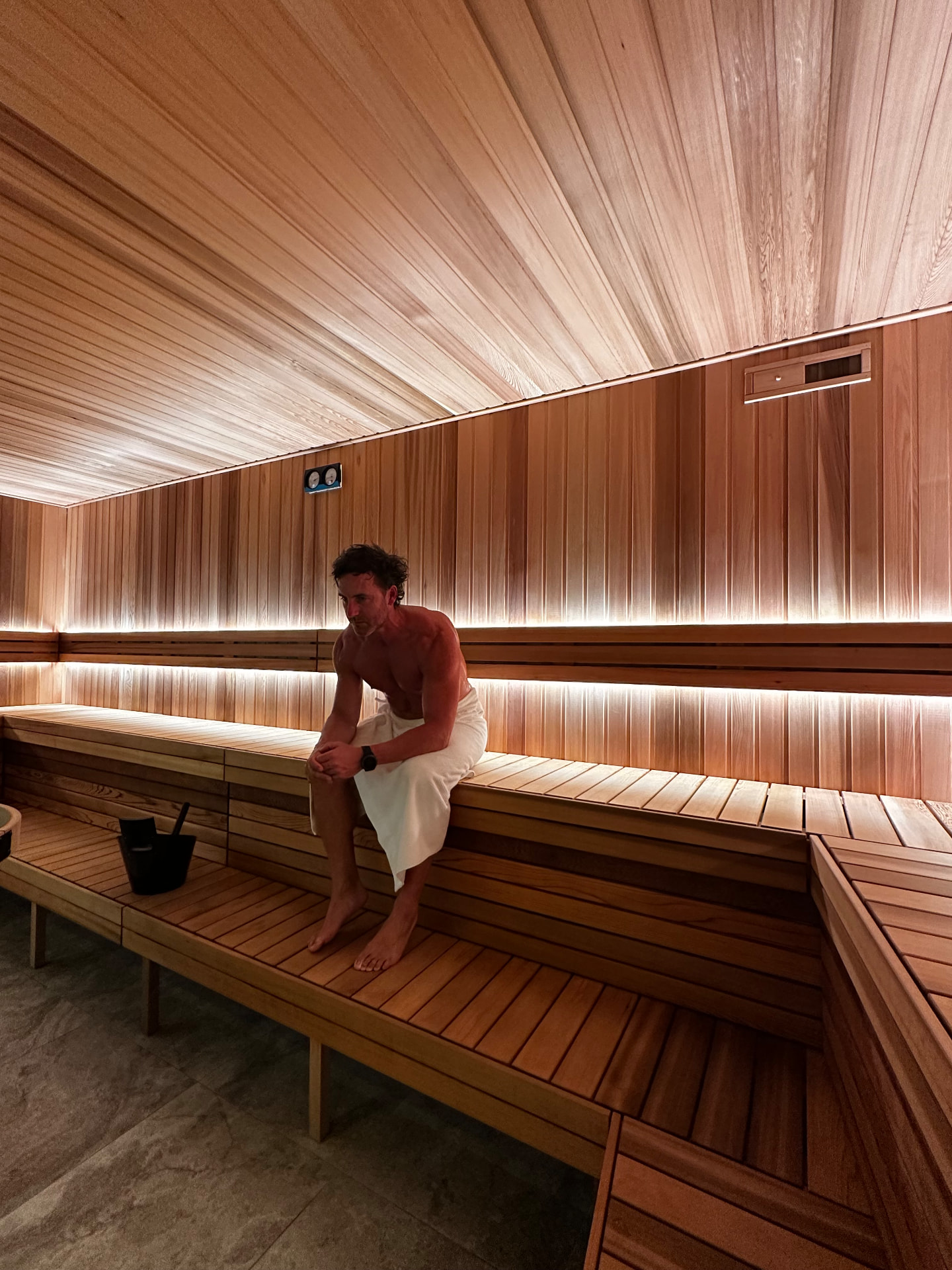
Home is your first place. Work is your second. Sociologist Ray Oldenburg spent a career arguing that the third place, the cafe, the gym, the sauna, the barbershop, is where community, recovery and good thinking actually happen. [1][2]
I am huge on this. Most days you will find me in one of three third spaces: a sauna, a place to work out, or a cafe to work and meet people. It is not a wellness habit for the sake of it. It is the structure that keeps the business and the person both running.
What is a third place, exactly? 🏠💼☕
Oldenburg defined third places as the informal public spots that sit between home and work, where conversation is the main activity, everyone is equal, and you can show up without an invitation or a deliverable. [1] They are neutral ground. Nobody owns the agenda. You are not someone's boss, employee, parent or partner. You are just a regular.
His research, and decades of work since, link these places to stronger communities and better individual wellbeing. Communities with accessible third places report a higher quality of life, and people who use them feel more connected to where they live. [3][6]
Why founders need one more than most 📈
Founders have a specific problem: work bleeds into home until there is no off switch left. The laptop is on the kitchen table. The Slack notifications arrive at dinner. When home and work are the same room, your brain never gets the signal to stand down.
A third space fixes this by geography. It is a deliberate physical boundary that is neither home nor office, and that boundary does real cognitive work. It gives your mind a place to transition, to think without a brief, and to have the conversations that never happen on a calendar invite.
The social side matters too. One of the largest meta-analyses ever run on social connection, covering more than 300,000 people, found that strong social relationships are associated with a 50% increased likelihood of survival, an effect comparable to quitting smoking. [4] Third places are where those loose, low-stakes relationships live: the barista who knows your order, the crew at the 6am class, the regulars in the sauna.
My three third spaces 🧖🏋️☕
The sauna. This is where recovery and thinking happen at the same time. Heat forces stillness: no phone, no laptop, no escape. And the physiology backs the ritual. A 20-year Finnish cohort study found that men who used a sauna four to seven times per week had significantly lower rates of fatal cardiovascular events and all-cause mortality than once-a-week users. [5] I built P3 Recovery around this belief, so yes, I am biased. I am also consistent.
The gym. A place to work out is a third space in the purest sense: shared, regular, merit-free. Nobody in the squat rack cares about your revenue. That is exactly the point. The hour where the only metric is the barbell is the hour that resets everything else.
The cafe. Oldenburg literally wrote the book on coffee shops. [1] Most days a cafe is my office, meeting room and thinking chair in one. Some of my best business conversations have happened across a small table with two flat whites, not in a boardroom. It is also where The Espresso Newsletter gets written, which felt worth mentioning.
How to find yours 🧭
Keep it simple. Pick a place that is not home and not work, that you can reach easily, and that you can show up to regularly without spending much. Then protect it like a meeting with your most important client, because that is what it is.
Build smart. Stay sharp. Sip the coffee. Preferably in your third space.
References 📚
- [1]Oldenburg, R. (1989). The Great Good Place: Cafes, Coffee Shops, Community Centers, Beauty Parlors, General Stores, Bars, Hangouts, and How They Get You Through the Day. Paragon House. The book that coined the term "third place."
- [2]Oldenburg, R., & Brissett, D. (1982). The Third Place. Qualitative Sociology, 5(4), 265–284. The original academic paper defining home, work, and the third place.
- [3]Project for Public Spaces. Ray Oldenburg & Third Places. Practical overview of the eight characteristics of great third places.
- [4]Holt-Lunstad, J., Smith, T. B., & Layton, J. B. (2010). Social Relationships and Mortality Risk: A Meta-analytic Review. PLoS Medicine, 7(7). Strong social relationships are associated with a 50% increased likelihood of survival.
- [5]Laukkanen, T., Khan, H., Zaccardi, F., & Laukkanen, J. A. (2015). Association Between Sauna Bathing and Fatal Cardiovascular and All-Cause Mortality Events. JAMA Internal Medicine, 175(4), 542–548. Regular sauna use linked to lower cardiovascular and all-cause mortality in a 20-year Finnish cohort.
- [6]Jeffres, L. W., Bracken, C. C., Jian, G., & Casey, M. F. (2009). The Impact of Third Places on Community Quality of Life. Applied Research in Quality of Life, 4(4), 333–345. Third place usage is positively associated with community quality of life.