
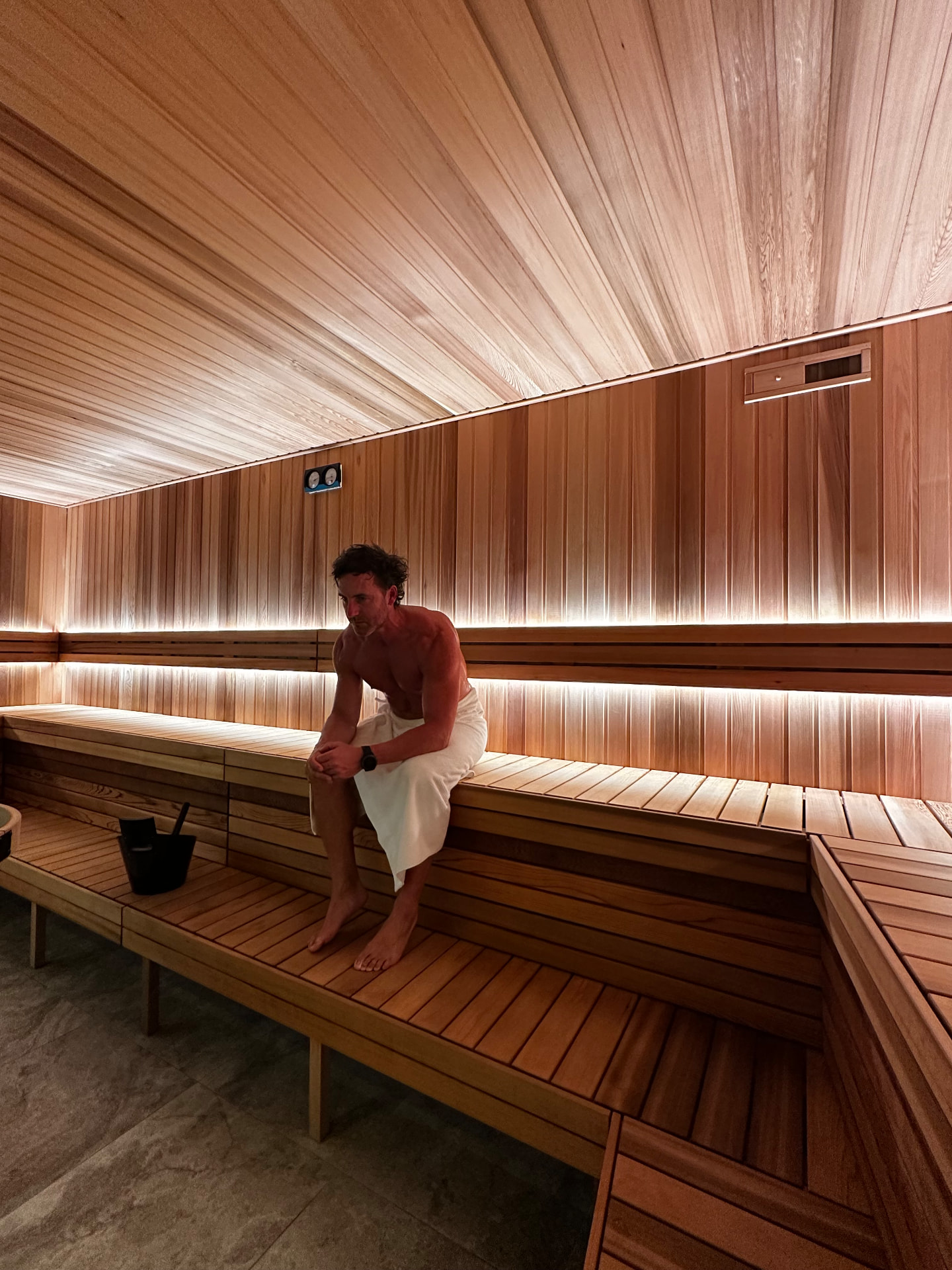
I am huge on sauna. It is part recovery session, part thinking space, and one of the few places where a phone has no business following you. But the science deserves more care than a neat minute-by-minute graphic can give it.
Your body does respond to heat in a sequence. The exact timing is not universal. Temperature, humidity, hydration, fitness, age and heat acclimation all change the experience. Think of this as a practical map, not a stopwatch.
Minutes 1 to 3: heat becomes the stressor
Your skin senses the heat first. Blood vessels near the surface begin to widen so the body can move heat outward. Heart rate starts climbing and sweating follows as your cooling system gets to work. Across human studies, a sauna session produces measurable rises in heart rate and core temperature. [1]
This is controlled stress, often called hormesis. The dose matters. More heat is not automatically more useful, and feeling unwell is not a sign that the session is working.
Minutes 4 to 7: circulation works harder
As skin blood flow increases, the heart works harder to maintain circulation. It can feel a little like low-to-moderate exercise, although sitting in a sauna does not replace training. Trials have reported short-term changes in blood pressure, arterial stiffness and blood-vessel function after sauna exposure. Regular sauna added to exercise has also improved several cardiovascular measures in a controlled trial. [1][2]
Minutes 8 to 12: the cellular stress response
Heat-shock proteins are part of the body's response to thermal stress. They help cells manage damaged or misfolded proteins. Small human studies have measured changes in HSP-70 after sauna use, but that does not prove a precise minute when repair switches on or a guaranteed health outcome. [3]
Acute heat can also change inflammatory signalling. A marker such as IL-6 may rise temporarily during heat stress, while frequent sauna use has been associated with lower resting inflammation in observational research. That is a more accurate story than saying a sauna simply flushes inflammation away. [4]
Minutes 13 to 20: where certainty runs out
This is where online claims often outrun human evidence. Autophagy, the process cells use to recycle damaged parts, is influenced by stress and is an important area of heat research. Current human evidence does not show that it reliably switches on at minute 13 of a sauna. A recent human study found the response was more complicated than that. [5]
Claims that a standard session repairs DNA or lengthens telomeres are not established by direct human sauna trials. These are proposed mechanisms drawn largely from laboratory and animal work. Interesting, yes. Proven in a person sitting through a 20-minute session, no.
Post sauna: the recovery is part of it
Once you step out, heart rate and temperature begin moving back toward baseline. The nervous system also rebalances during the cooldown, although studies show that the pattern varies between people and protocols. [6] This is why I do not rush the exit. Cool down gradually, drink water and give the session a clean ending.
Long-term Finnish studies have found that frequent sauna users had lower cardiovascular and all-cause mortality than less-frequent users. That is an association, not proof that sauna alone caused the difference, but it is one of the strongest reasons researchers continue to take passive heat seriously. [7]
The routine I care about most
Consistency beats hero sessions. Start with a heat level and duration you tolerate comfortably. Leave immediately if you feel dizzy, nauseous, confused or unwell. Rehydrate afterward, avoid alcohol around the session, and do not treat discomfort as a badge of honour.
If you are pregnant, have cardiovascular or blood-pressure concerns, take medication affected by heat or fluid balance, or have been advised to limit heat exposure, speak with a qualified health professional first.
The value is not in chasing a magical minute. It is in building a sustainable ritual that helps you slow down, recover and return to the work sharper than you entered.
References
- [1]Li, Z., et al. (2020). Acute and short-term efficacy of sauna treatment on cardiovascular function: A meta-analysis. Chronic Illness. Human studies show acute rises in heart rate and body temperature during sauna exposure.
- [2]Lee, E., et al. (2022). Effects of regular sauna bathing in conjunction with exercise on cardiovascular function: A multi-arm randomized controlled trial. American Journal of Physiology. Regular sauna use alongside exercise improved several measures of cardiovascular function.
- [3]Pilch, W., et al. (2023). The effects of a single and a series of Finnish sauna sessions on the immune response and HSP-70 levels in trained and untrained men. International Journal of Hyperthermia. A small human study measuring heat-shock protein responses after sauna sessions.
- [4]Kunutsor, S. K., et al. (2022). Inflammation, sauna bathing, and all-cause mortality in middle-aged and older Finnish men: a cohort study. European Journal of Epidemiology. Frequent sauna use was associated with lower resting inflammation and mortality risk.
- [5]McCormick, J. J., et al. (2025). The effect of an exercise- and passive-induced heat stress on autophagy in young and older males. American Journal of Physiology. Human evidence for heat-induced autophagy remains early and does not support a precise sauna timeline.
- [6]Castro Ferreira, F., et al. (2023). Cardiovascular autonomic modulation during passive heating protocols: a systematic review. Physiological Measurement, 44, 01TR01. Autonomic responses during heating and cooling vary between protocols and individuals.
- [7]Laukkanen, T., et al. (2018). Sauna bathing is associated with reduced cardiovascular mortality and improves risk prediction in men and women: a prospective cohort study. BMC Medicine, 16, 219. A long-term Finnish cohort found an association between frequent sauna use and lower cardiovascular mortality.