
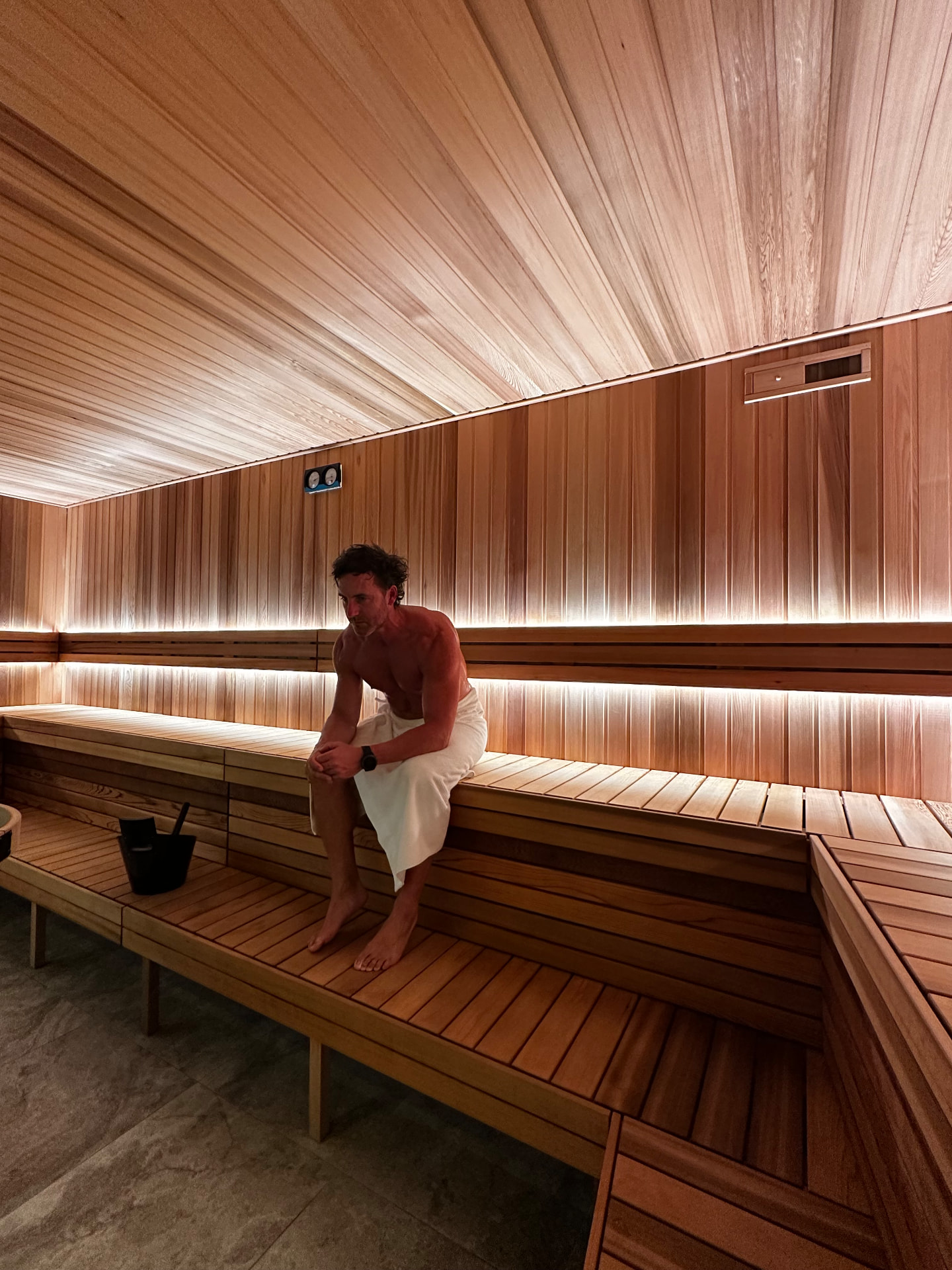
Recovery has become an industry of its own. Cold plunges, red light panels, hyperbaric chambers, saunas with Bluetooth. Some of it works. Some of it is expensive marketing. And a surprising amount of it is somewhere in between: real physiological effects, oversold promises.
Full disclosure: I built P3 Recovery around this space, so I have a horse in the race. That is exactly why I try to stay honest about what the human evidence does and does not support. Here is the stack, tool by tool, with the receipts.
Sauna: the strongest case 🧖
Heat is the one tool in the stack with the deepest human dataset behind it. The Finnish cohort work that keeps getting cited followed more than 2,300 middle-aged men for about 20 years and found that men using a sauna four to seven times a week had meaningfully lower rates of fatal cardiovascular events and all-cause mortality than once-a-week users. [1]
The honest caveat: this is an association, not proof that sauna causes longevity. People who sauna regularly tend to have other healthy habits too. But the physiological story is plausible: repeated heat exposure works the cardiovascular system like moderate exercise. I wrote a full article on what happens to your body in a sauna if you want the detail.
Cold: real relief, unclear upside 🥶
Cold water immersion has solid evidence for one thing: it reduces the feeling of muscle soreness after hard exercise. A Cochrane review found some evidence of reduced soreness at 24 to 96 hours after training, while also noting that study quality was low and the optimal method is not clear. [2]
The sharper question is whether the cold helps you adapt. Some research suggests blunting inflammation immediately after strength sessions may mute part of the training signal. My rule of thumb: cold for relief and for the mental toughness ritual, not immediately after a session you want to count as growth.
Red light: promising, dose-dependent 🔴
Photobiomodulation, red and near-infrared light, is one of the more interesting areas in recovery right now. The human evidence supports three things:
Muscle soreness. A 2025 meta-analysis found that applying red light before exercise reduced soreness roughly 12 points on standard soreness scales 24 hours later. [3] Notably, pre-exercise timing outperformed post-exercise in that analysis.
Skin. Controlled trials show improvements in skin roughness and collagen density with twice-weekly sessions over 12 weeks. [4]
What it does not support, yet. Immediate performance gains are inconsistent across studies, fat loss claims rest on thin mechanisms, and "full-body systemic healing" from treating one area is not something human research has validated. [5]
Two practical notes. Dosing matters enormously: light therapy follows a biphasic dose-response, meaning too little does nothing and too much can undo the benefit. [5][6] And check what your panel actually is: "FDA registered" only means the manufacturer is on file, while "FDA cleared" is the higher bar for specific uses. Protect your eyes around high-intensity panels.
Hyperbaric: medical tool, wellness question mark ⭕
Hyperbaric oxygen therapy is legitimately established, at clinical pressures, for specific conditions: decompression sickness, carbon monoxide poisoning, diabetic wounds and compromised grafts. The FDA is explicit that the long list of marketed uses beyond those, from cancer to anti-aging, is not supported. [10]
For recovery, the picture is genuinely mixed. A 2025 meta-analysis found HBOT can speed recovery from exercise-induced muscle injury,[8] while the older Cochrane review found insufficient evidence for soreness. [7] The famous 2020 Israeli telomere study, the one behind the "reverse aging" headlines, involved 35 adults, no control group, and a very specific clinical protocol. [9] Interesting science, nowhere near a consumer proof point.
One more thing worth knowing: the mild soft chambers marketed for home use run at around 1.3 ATA, well below the clinical definition of hyperbaric oxygen therapy, and regulators have raised concerns about using them with supplemental oxygen. Ear discomfort is the most common side effect even at mild pressures.
How I would stack it 🧭
If I had to rank the stack by evidence per dollar, it would look like this:
1. Sauna. The most human evidence, the biggest effects, and the cheapest habit to build. Even a gym sauna twice a week is a start.
2. Cold. Real relief, and a genuinely useful mental tool. Just keep it away from the sessions you most want to adapt from.
3. Red light. The most interesting emerging tool, with honest evidence for soreness and skin. Treat the dosing as seriously as the marketing would like you to treat the light itself.
4. Hyperbaric. The most expensive and the least proven for healthy people. If you enjoy the sessions, fine. Just do not buy the longevity story yet.
And underneath all of it sit the three things no gadget replaces: sleep, consistent training and food. The stack amplifies those. It does not substitute for them.
Build smart. Stay sharp. Sip the coffee.
References 📚
- [1]Laukkanen, T., Khan, H., Zaccardi, F., & Laukkanen, J. A. (2015). Association Between Sauna Bathing and Fatal Cardiovascular and All-Cause Mortality Events. JAMA Internal Medicine, 175(4), 542-548. The 20-year Finnish cohort linking frequent sauna use to lower cardiovascular and all-cause mortality.
- [2]Bleakley, C., Baxter, G. D., Hopkins, J. T., & Davison, G. W. (2012). Cold-water immersion (cryotherapy) for preventing and treating muscle soreness after exercise. Cochrane Database of Systematic Reviews, (2), CD008262. Cold water immersion reduces soreness after exercise, though the optimal method and its safety are not clear.
- [3]Canez, M. S., et al. (2025). Effects of photobiomodulation therapy on muscle recovery: systematic review with meta-analysis. Journal of Bodywork and Movement Therapies. Meta-analysis finding red light applied before exercise reduced muscle soreness 24 hours later.
- [4]Wunsch, A., & Matuschka, K. (2014). A Controlled Trial to Determine the Efficacy of Red and Near-Infrared Light Treatment in Patient Satisfaction, Reduction of Fine Lines, Wrinkles, Skin Roughness, and Skin Surface Lipid Content, and Collagen Density. Photomedicine and Laser Surgery, 32(2), 93-100. Controlled trial showing improvements in skin roughness and collagen density over 12 weeks.
- [5]Selting, W., & Hamblin, M. R. (2018). Review of light parameters and photobiomodulation efficacy: dive into complexity. Journal of Biomedical Optics, 23(12), 120901. Why dosing matters: light therapy follows a biphasic dose-response, where too little or too much both fail.
- [6]Leal-Junior, E. C. P., et al. (2019). Clinical and scientific recommendations for the use of photobiomodulation therapy in exercise performance and recovery. Brazilian Journal of Physical Therapy, 23(2), 71-75. Dosing recommendations for athletic applications, and why device specs matter.
- [7]Bennett, M. H., et al. (2010). Hyperbaric oxygen therapy for delayed onset muscle soreness and closed soft tissue injury. Cochrane Database of Systematic Reviews, (4), CD004713. Cochrane review finding insufficient evidence to recommend HBOT for soreness from hard training.
- [8]Luo, X., Yu, Y., et al. (2025). Effects of Hyperbaric Oxygen Therapy on Exercise-Induced Muscle Injury and Soreness: A Systematic Review and Meta-analysis. Archives of Physical Medicine and Rehabilitation. Newer meta-analysis suggesting HBOT can speed recovery from exercise-induced muscle injury.
- [9]Hachmo, Y., Hadanny, A., et al. (2020). Hyperbaric oxygen therapy increases telomere length and decreases immunosenescence in isolated blood cells. Aging, 12(22), 22445-22456. The small Israeli trial behind the anti-aging headlines; 35 adults, no control group, specific protocol.
- [10]U.S. Food and Drug Administration. Hyperbaric Oxygen Therapy: Get the Facts. The FDA's list of established HBOT uses and its warnings against unproven claims.