
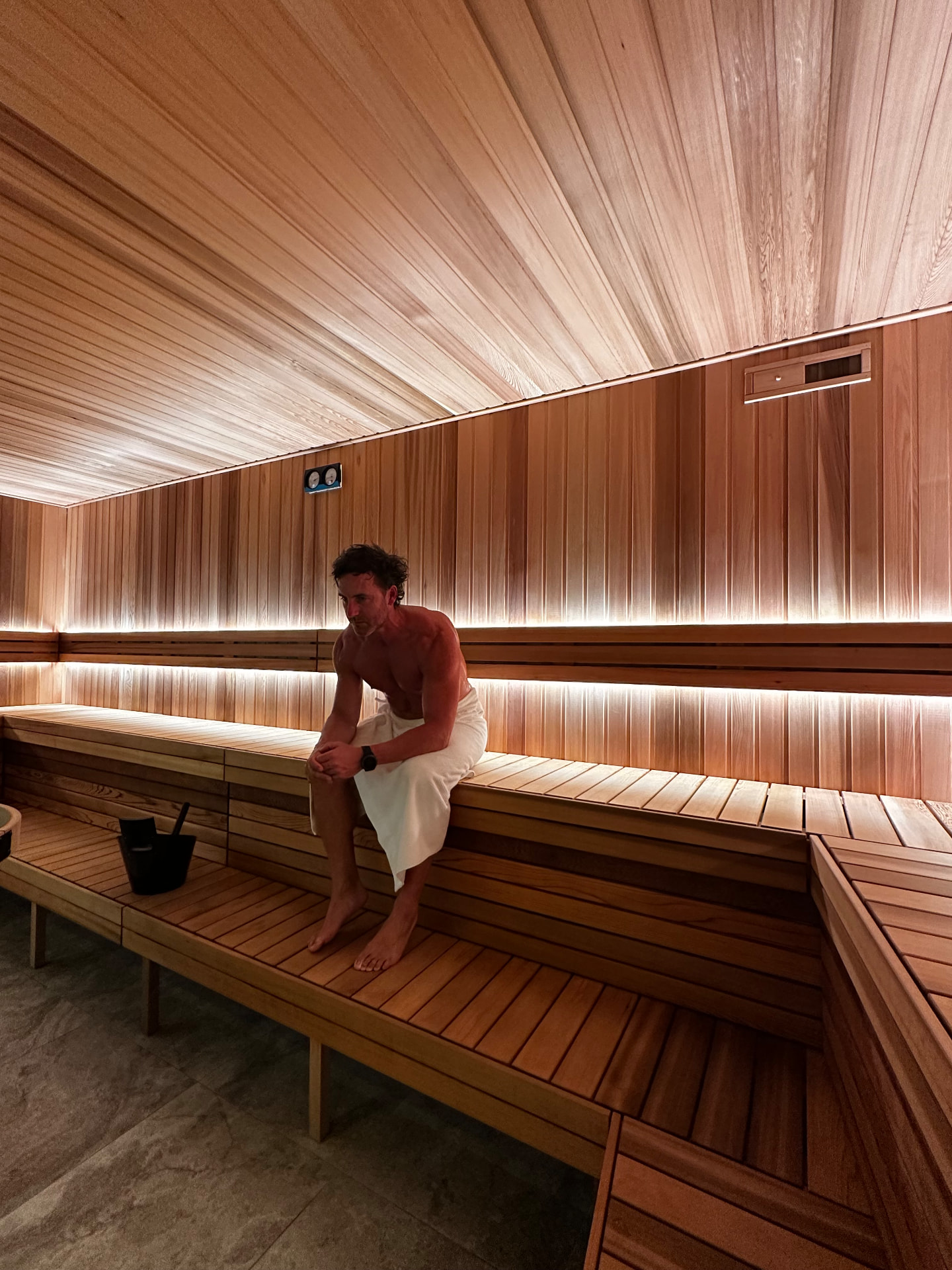
After a long endurance session, your body does not need another test of toughness. It needs the chance to repair. The run, ride or long day in the mountains is the stimulus. Recovery is what makes the next session possible.
Sauna and red light are an appealing combination: heat, a quieter moment, and a tool with some promising muscle-recovery research behind it. But “watch the magic” skips the important part. What does each actually do, and is stacking them better than using either alone?
First, earn the right to add heat
A long effort can leave you hot, depleted and short on fluid. Walking straight into a sauna adds more heat stress and more sweating. That is not automatically recovery.
Cool down first. Replace fluids and electrolytes according to your losses, eat a meal or snack with carbohydrate and protein, and give yourself time to settle. If you still feel overheated, light-headed, nauseated or unusually exhausted, skip the sauna. A recovery tool should not make a depleted body work harder.
Sauna: circulation, not a detox shortcut
Heat increases blood flow to the skin and raises heart rate as your body works to cool itself. Those are real physiological responses. Regular sauna bathing has been studied for a range of health outcomes, but the studies vary in quality and do not prove that a post-endurance sauna reliably accelerates muscle repair. [1]
The claim that sauna “clears metabolic waste” needs more care. Sweating is primarily a cooling mechanism, not a special detox system. Lactate is a useful fuel and is normally processed after exercise; it is not the cause of next-day muscle soreness.
A sauna can still be a worthwhile ritual if you tolerate it well. The quieter setting and transition out of training mode may be valuable in their own right. Just do not confuse a rise in circulation with proof of faster recovery. For the wider picture, read what happens to your body in a sauna.
Red and near-infrared light: promising, specific
Photobiomodulation uses particular doses of red or near-infrared light. Proposed mechanisms include effects on cellular energy signalling and mitochondrial activity. Those mechanisms are a reason to investigate it, not a guarantee that every panel improves recovery.
Human exercise research has explored possible benefits under specific conditions, often by applying light before exercise. A meta-analysis of pre-exercise treatment found that effects varied by exercise mode. That is not evidence that applying light after a long endurance session reliably speeds recovery. Timing matters, and the two claims should not be treated as interchangeable. [2]
Wavelength, dose, distance, treatment area and timing all matter. Research using targeted treatment on a muscle group does not automatically validate standing in front of a whole-body panel. “Reduces inflammation” is also too broad as an unconditional claim: changing a laboratory marker is not the same as proving better training adaptation. [3]
A 2025 review of whole-body photobiomodulation included just five studies and 105 participants, and found no benefit for exercise performance or fatigue biomarkers. That is a useful counterweight to broad recovery promises from consumer panels. [4]
Does stacking them create an extra benefit?
The research cited here does not establish that sauna plus red light after endurance training outperforms either on its own. Two plausible tools do not automatically add up to a proven protocol.
It is reasonable to explore them as optional additions to a recovery routine, provided the claims stay modest. Less soreness and a faster bounce-back are not established promises from this combination. More consistent training comes from matching the workload to the recovery you can actually sustain.
A practical post-effort ritual
- Settle first. Finish the effort, cool down and check how you feel. Avoid piling heat onto an already overheated body.
- Refuel and rehydrate. Make food and fluid replacement the foundation, not an afterthought.
- Keep heat optional. If you feel well and are accustomed to sauna, keep the session comfortable. Leave immediately if you feel dizzy or unwell. Do not chase a temperature or a sweat target.
- Treat light as a specific tool. Follow your device's instructions and eye-safety guidance. Do not use a panel in a hot or wet sauna unless it is explicitly designed for that environment.
- Protect the night. Prioritise sleep and adjust the next session to your actual recovery, rather than assuming a gadget has erased the workload.
This is general information, not a personalised treatment plan. Check with a clinician before heat exposure if you have a relevant medical condition, are pregnant, or take medication that affects heat tolerance or blood pressure. Avoid alcohol around sauna use. Persistent or severe symptoms after endurance exercise need medical attention, not another recovery session.
Your business runs on recovery too
The same principle applies to work. A team cannot deliver consistently if every week is treated like a finish-line sprint. Leading growth includes protecting the capacity of the people doing the work, not just demanding more output.
Your business and your body run better when recovery is non-negotiable. Not because sauna and light are magic, but because a repeatable routine makes room for the basics. The tools support the system. They do not replace it.
What is your go-to post-effort ritual?
For the broader evidence across heat, cold, light and hyperbaric oxygen, explore the recovery stack, without the hype. For the business connection, read what ultra endurance taught me about business.
References
- [1]Ahokas, E. K., et al. (2025). Effects of Post-Exercise Heat Exposure on Acute Recovery and Training-Induced Performance Adaptations: A Systematic Review. Sports Medicine – Open. Reviews a small, mixed body of post-exercise heat studies. Acute recovery and longer-term adaptation remain uncertain.
- [2]Dutra, Y. M., et al. (2022). Deconstructing the Ergogenic Effects of Photobiomodulation: A Systematic Review and Meta-analysis of its Efficacy in Improving Mode-Specific Exercise Performance in Humans. Sports Medicine. Examines pre-exercise treatment and effects that vary by exercise mode. It does not establish post-endurance recovery benefits.
- [3]Leal-Junior, E. C. P., et al. (2019). Clinical and scientific recommendations for the use of photobiomodulation therapy in exercise performance and recovery. Brazilian Journal of Physical Therapy. Explains why wavelength, dose, treatment area and timing matter for exercise applications.
- [4]Álvarez-Martínez, M., & Borden, G. (2025). A systematic review on whole-body photobiomodulation for exercise performance and recovery. Lasers in Medical Science, 40, 55. Five studies with 105 participants found no benefit for exercise performance or fatigue biomarkers. Whole-body light evidence is limited.